10 March 2008

Variations on a Theme - "Crop Circles"


Bespoke rug designer, Luke Irwin


They may not work for everyone, but they sure are Most Excellent. These rugs by designer, Luke Irwin are from his "Crop Circles" collection. I love the colors and the fluidity they add to a room. I am also fond of the way such a contemporary pattern can feel perfectly at home and foil a more traditional environment.

Luke Irwin was born in Dublin in the late 1960’s and has had a varied career in many fields before founding his bespoke rug company. Starting in theatre and opera Luke went on to work in public relations, as a theatrical agent and in fine antiques before setting up "Luke Irwin" in 2003.

He has a very definite view on rug design that is apparent in the uniqueness of the designs and themes that run through his portfolio.

The main intention in founding "Luke Irwin" was to create a service that would give the customer complete choice and control over their own rug. With a wide range of possible choices to be made concerning the size, color, weave, textile and design Luke Irwin aims to offer each customer a truly bespoke and personal piece.

The design company believes that the importance of a rug in any given room is often greatly underestimated; it is the cornerstone or foundation on which all the elements and personality within that room are bound together whether this is through color or design.

In many ways the rug should be the last thing you notice but when you do the ingenuity of the creativity involved to make that room blend is revealed. There are many areas where a rug should be a stand alone feature and this is generally achieved through color.
http://www.lukeirwin.com


"Beetles"

05 March 2008

DC Modern Luxury - March 2008


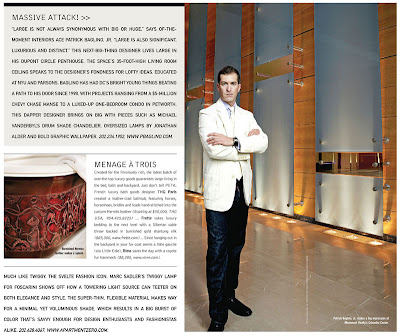
DC Modern Luxury magazine featured me in their March 2008 Fashion and Home issue. The feature entitled "Living Large" appears above. I would like to extend my special thanks to Associate Editor Tiffany Jow of DC Modern Luxury, Photographers Greg Powers, Audrey Crewe and my assistant, Megan Blake. (A larger version of the feature is available to be viewed at http://www.pbaglino.com)


Wickedly Hot Coffee Tables.

"Groundfloor" square coffee table design with flame


My friend Matt in New York brought these Most Excellent coffee tables to my attention. I think it would be tremendously cool to install one of these coffee or side tables as the centerpiece of a room. Imagine the dramatic impact! An apartment or home without a fireplace now has a stunning alternative.

A coffee table with real fire! Manufactured by Planika fires there are several table versions. Composed of glass, wood or slate in a variety of wood species and finishes. These are truly pieces of furniture with a double function. The forms resemble a typical coffee table or side table. The Glassfire® Technology included in the construction of each model allows enjoyment of the ambience of fire. The "Groundfloor" design, (shown above and below), was designed by a French designer Christophe Pillet, and comes in two finishes. American black walnut veneer is placed alongside ruby red or traffic white high gloss varnishes. Groundfloor is hand-made in Europe and does not require any flue installation.

Planika Fires use biofuel FANOLA®. As a result, the fire is free of smoke or smell. Having been thoroughly tested, the fuel received a positive opinion of specialists from the Environmental Toxicology Department of the National Institute of Hygiene as regards its safety for people and the environment with reservation of use in accordance with designation, label instructions and operations manual. FANOLA® is a biologically clean product of plant origin, which has undergone rectification three times. It constitutes a wholly renewable source of energy. Burning FANOLA® is not accompanied by fumes or smell. Only water vapor and CO2 are emitted - in proportions similar to those contained in the air exhaled by humans.

Planika Fires do not require any special installation. Each model comes with easy and detailed instructions of usage and assembly. It is possible to enjoy real fire after 10 minutes of receiving the product. The lighting of Planika Fire is extremely easy and safe. After filling the container with FANOLA® fuel, a special lighter, with an extended tip, is used to ignite the charm of the living fire in an instant. http://www.planikafires.com


"Groundfloor" design by French Designer, Christophe Pillet


Long coffee table design in wood with chrome legs


Square table design in natural slate


"Veranda" glass fire side table


Square table design in natural slate

04 March 2008

HRH Charles, The Prince of Wales. Home collection.


Guess who has entered the home furnishings area? It’s Prince Charles. The man who certainly knows great luxury has unveiled a line of luxury goods and aims to take on the Tiffanys, Wedgwoods and Waterfords of the world.

Called Traditional Arts, the collection consists of china, crystal and silver designed by graduates of the Prince’s School of Traditional Arts in East London and other young designers. The products went on sale in Britain and the Middle East in January 2008 and are set to debut in American stores later this year. Their colorful and delicate designs—featuring lotuses, suns and moons, swirling arabesques and tiny geometric patterns—are inspired by 11th- century Islamic manuscripts, miniature Mughal paintings and motifs from Egyptian myths.

Each design has a raison d’être, an approach that embodies the philosophy of the school, which is dedicated to reviving and preserving arts and crafts traditions. Traditional Arts made the decision to produce the items at small companies—including Caverswall China, Staffordshire Crystal and Grant Macdonald—throughout Europe. Traditional Arts also takes custom orders, unlike most major brands.

It should be mentioned that HRH Prince of Wales is not new to selling luxury goods. In 1992, he launched a line of comestibles called Duchy Originals. The line features organic food and soaps, and generates $100 million in annual sales. The profits from both Duchy Originals, and Traditional Arts will be sent directly to the Prince’s Charities Foundation, the umbrella organization that includes the arts school, one of just a few in the West that teaches subjects such as stained-glass-window making, gilding, lettering and Islamic calligraphy. This autumn the brand will move beyond the tabletop and begin offering cuff links, neckties and carpets. Also planned are leather journals made of the hides of deer that roamed the Balmoral estate, the royals’ summer residence in Aberdeenshire, Scotland.


Offerings from the Traditional Arts line include the Sun & Moon teapot and round boxes featuring Mughal elephants.


Biscuits and Blueberry preserves from the Prince's Duchy Originals line
http://www.duchyusa.com

03 March 2008

Form and Function.


Joris Laarman in his Rotterdam studio


Joris Laarman Studio, The Netherlands

Dutch designer, Joris Laarman is quite the innovator. Not only does he create products that are functional, he designs Most Excellent things that are a combination of high tech and high style. At the age of 23, Laarman dreamed up the concept of a modular concrete radiator with a curlicue shape that could be mounted on a wall. The spectacular creation, (Laarman's senior project at design school), is a beautiful and artistic expression that goes far beyond what one would think of when considering a radiator. His radiator, with baroque curves inspired by antique French wallpaper, happened to heat a room more efficiently than a standard metal rectangle.

Joris Laarman did not stop there. His studio currently boasts creations that include the "Nebula" lamp for Flos. The fixture is a constellation of different size lampshades joined as a bunch to emit an explosion of light from it's core. Another beautiful and functional design is the "Stakanov". This tower of ceramic cups or soup bowls can be piled high. Not only is the stack beautiful it functions nicely in hotels or restaurants who have a volume of business that would necessitate such an ingenious creation.

For 2008, Joris and his Rotterdam studio has introduced the "Bone" chair and chaise lounge. The armchair and lounge is composed of porcelain with marble powder and resin. "Combining reason with emotion, that's the most difficult thing to do - in design and everything", Laarman says.

The Bone Chair is one extraordinary example of Laarman’s ability to merge the two. The chair design is one he developed on a computer and then cast in aluminum. For the form, Laarman relied on software that car manufacturers use to develop the most efficient shapes for auto parts. (The software was originally inspired by the biology of human bones, whose regenerative capacity allows them to add and subtract matter as needed.) The result is a delicately sculptural object that contains no superfluous or decorative matter yet is gorgeous enough to make people marvel. The chair is currently on exhibit at the Freidman Benda gallery in New York City, as well as the MoMA.
http://www.jorislaarman.com


The Joris Laarman Radiator installed on a wall


Laarman radiator installed behind an office front reception desk


Conceptual drawing of the Laarman radiator. The fixture is claimed to heat a room more efficiently than a standard metal rectangle.


Detail of Laarman radiator connected to main heat source


The Bone Chair and Chaise Lounge


Laarman's "Bone" chair - cast in aluminum


Joris Laarman "Bone" Chaise Lounge in porcelain, marble powder and resin


Bone Chaise Lounge


Bone Chaise Lounge - detail


"The Nebula" light fixture for Flos. "Stakanov", stack of cups with handles. (below)